For beekeepers aiming to establish thriving colonies, the choice between nucleus hives and packaged bees significantly impacts long-term productivity. Research shows nucleus hives—with their locally adapted bees and pre-integrated queens—consistently outperform packages in colony stability, honey production, and winter survival. This data-driven comparison reveals why commercial apiaries increasingly favor nucleus hives, and how to mitigate risks when using packages.
Choosing Between Nucleus Hives and Packages
Colony Stress: Local Sourcing vs. Long-Distance Shipping
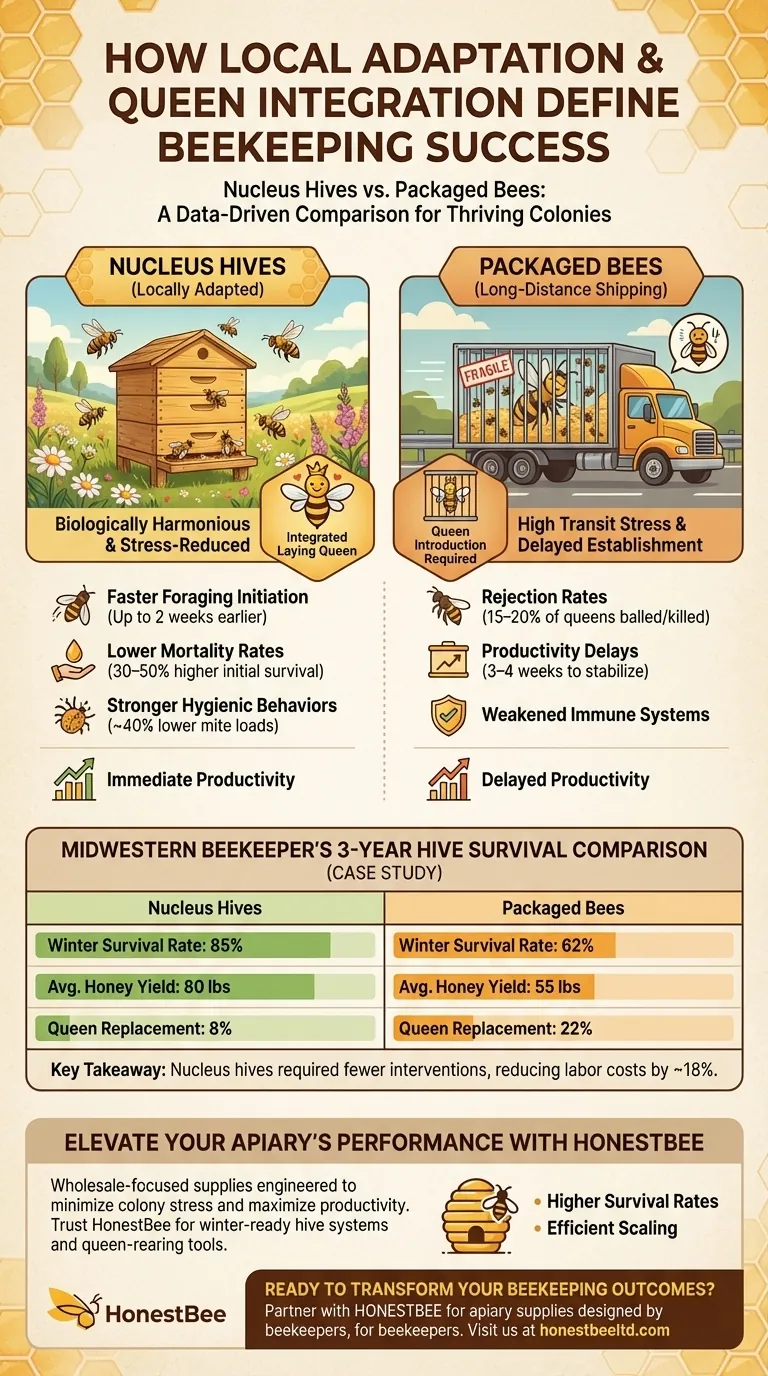
Nucleus hives leverage bees bred for regional conditions, reducing stress from climate adaptation. In contrast, packaged bees often endure days in transit, weakening their immune systems and delaying colony establishment.
Key advantages of local sourcing:
- Faster foraging initiation: Locally adapted bees begin nectar collection up to 2 weeks earlier.
- Lower mortality rates: Studies suggest 30–50% higher survival during initial hive setup.
Queen Acceptance Timelines and Colony Productivity
Nucleus hives ship with an already mated, egg-laying queen accepted by the colony. Packages require queen introduction—a process with inherent risks:
- Rejection rates: Approximately 15–20% of caged queens in packages are balled or killed by workers.
- Productivity delays: Colonies may take 3–4 weeks to stabilize post-introduction, versus immediate productivity in nucleus hives.
Pro Tip: Push-in cages can improve package queen acceptance by allowing her to lay eggs in a protected space, making her pheromones more familiar to workers.
Pest Resistance and Disease Management
Locally raised nucleus colonies often exhibit stronger hygienic behaviors—a trait linked to:
- Varroa mite resistance: Bees groom more aggressively, reducing mite loads by ~40% compared to non-adapted packages.
- Disease resilience: Regional adaptation enhances immune responses to prevalent pathogens.
Optimizing Beekeeping Success
Case Study: Midwestern Beekeeper’s 3-Year Hive Survival Comparison
A commercial operation tracking 200 hives annually found:
| Metric | Nucleus Hives | Packages |
|---|---|---|
| Winter survival rate | 85% | 62% |
| Avg. honey yield | 80 lbs | 55 lbs |
| Queen replacement | 8% | 22% |
Key takeaway: Nucleus hives required fewer interventions, reducing labor costs by an estimated 18%.
Mitigating Risks When Using Packages
For beekeepers using packages, these strategies improve outcomes:
- Acclimatization: Keep packages in a cool, dark place for 24 hours before installation.
- Comb foundations: Provide drawn comb to accelerate brood production.
- Supplemental feeding: Use 1:1 sugar syrup until natural forage is established.
Elevate Your Apiary’s Performance with HONESTBEE
Commercial beekeepers and distributors trust HONESTBEE’s wholesale-focused supplies to support nucleus hive success—from insulated hive covers to queen-rearing tools. Our equipment is engineered to minimize colony stress and maximize productivity, helping you achieve:
- Higher survival rates through winter-ready hive systems
- Efficient scaling with bulk-order beekeeping essentials
Ready to transform your beekeeping outcomes? Partner with HONESTBEE for apiary supplies designed by beekeepers, for beekeepers.
Final Insight: The quiet advantage of nucleus hives lies in their biological harmony—bees, queen, and comb working as an evolved unit from day one. For operations prioritizing resilience over short-term cost savings, this alignment proves invaluable.
ビジュアルガイド
関連製品
- 養蜂用5枠木製ヌックボックス
- ミツバチ女王蜂の交尾のための自動熱保存6フレームプロNucボックス
- 4 養蜂のためのフレームのプラスチック Nuc 箱 蜂の Nuc 箱
- フレキシオンミツバチの巣箱ゲート用スチールラウンドディスクエントランスレデューサー
- 発泡スチロールのミニ交尾ヌックボックスとフレームフィーダー 発泡スチロールの蜂の巣 3 フレーム ヌックボックス





