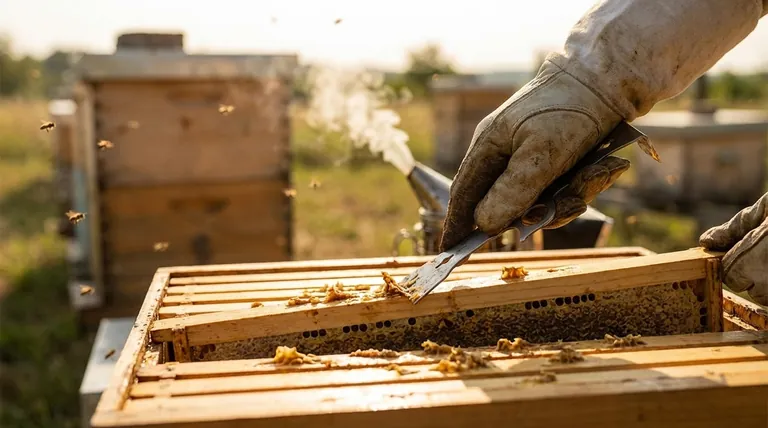
A Tale of Two Hives
An experienced beekeeper finishes inspecting a strong, productive colony. With practiced efficiency, she scrapes the propolis from her hive tool onto the inner cover, gives it a quick wipe on her pants, and moves to the next hive. The tool looks clean. The process feels right.
But the most significant threats in an apiary are the ones you cannot see. This simple, common act is a gamble. It relies on the assumption that the first hive was perfectly healthy, an assumption that ignores the microscopic world of pathogens that thrive in wax and propolis.
This is a cognitive trap. We are wired to react to visible threats—a wasp, a mouse, a failing queen. We discount invisible risks. But in beekeeping, the invisible—spores, viruses, bacteria—can trigger a cascade of failure across an entire operation. True apiary biosecurity is a systems discipline, and its most critical leverage point is the humble hive tool.
The Anatomy of a Vector
Your hive tool is the single piece of equipment that touches everything: frames, honey, brood, propolis, and the bees themselves. This universal contact makes it the perfect vehicle for disease.
The Sticky Matrix
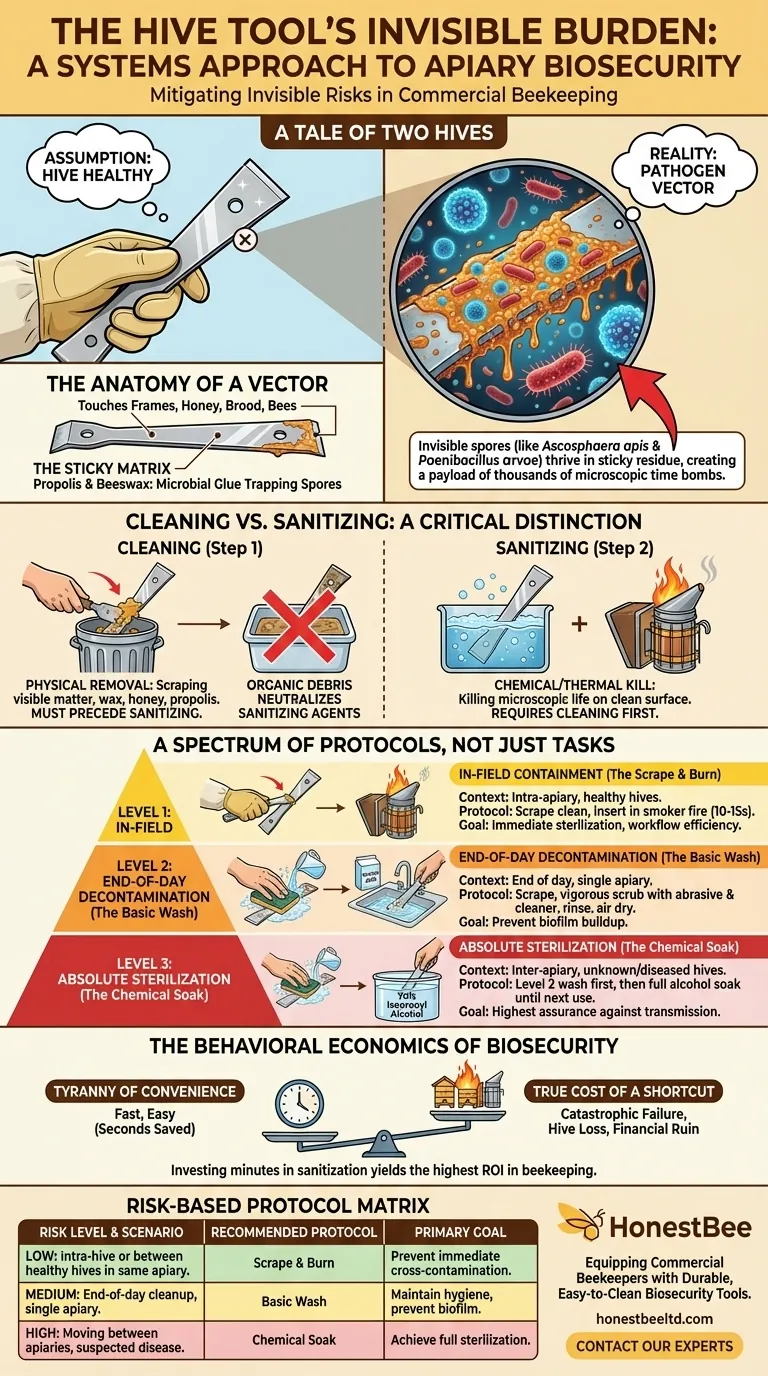
Propolis and beeswax are not just building materials; they are microbial glue. Their sticky, resinous nature is incredibly effective at trapping and preserving fungal spores like Ascosphaera apis (chalkbrood) and the terrifyingly resilient spores of Paenibacillus larvae (American Foulbrood).
A tool that appears clean to the naked eye can carry a payload of thousands of these microscopic time bombs.
Cleaning vs. Sanitizing: A Critical Distinction
These terms are not interchangeable, and confusing them is a foundational error in biosecurity.
- Cleaning is the physical act of removing visible matter. It is about scraping away the wax, propolis, and honey. It is step one.
- Sanitizing is the chemical or thermal process of killing microscopic life on the now-clean surface. It is step two.
You cannot sanitize a dirty tool. Organic debris neutralizes sanitizing agents and shields pathogens, rendering the effort useless. Effective sanitization must be preceded by thorough cleaning.
A Spectrum of Protocols, Not Just Tasks
The right method for hive tool hygiene is not a single answer but a protocol matched to the level of risk. Thinking in terms of risk management elevates the task from a chore to a professional discipline.
Level 1: In-Field Containment (The Scrape & Burn)
Context: For rapid work between frames or healthy hives within the same apiary. Protocol: Scrape the tool clean of all visible debris. Then, insert the blade into the hot fire pot of your smoker for 10-15 seconds. The intense heat is highly effective at killing surface pathogens. Rationale: This method provides excellent, immediate sterilization, balancing workflow efficiency with a high degree of biosecurity for localized tasks.
Level 2: End-of-Day Decontamination (The Basic Wash)
Context: Concluding work in a single, known-healthy apiary for the day. Protocol: Scrape off all heavy buildup. Vigorously scrub the tool with an abrasive pad (like stainless steel wool), hot water, and a cleaning agent like washing soda to break down all remaining residue. Rinse clean and allow to air dry completely. Rationale: This process resets the tool to a clean baseline, preventing the accumulation of a hardened biofilm of wax and propolis that can harbor pathogens over time.
Level 3: Absolute Sterilization (The Chemical Soak)
Context: The gold standard. This is mandatory when moving between different apiaries, inspecting hives of unknown health status, or working in a yard with suspected or confirmed disease. Protocol: Perform a complete Level 2 wash first. After rinsing and drying, fully submerge the tool in a dedicated container of 70% isopropyl alcohol. Leave it to soak until its next use. Rationale: This provides the highest possible level of assurance against disease transmission. For commercial operations, where the health of hundreds of colonies is at stake, this is the only acceptable protocol for inter-apiary work.
The Behavioral Economics of Biosecurity
If the protocols are so clear, why do lapses happen? The reason lies in psychology. We systematically undervalue the prevention of a disaster that hasn't happened yet.
The Tyranny of Convenience
The Scrape & Burn takes 15 seconds. A full Chemical Soak protocol takes several minutes and requires dedicated supplies. It feels inefficient. This is the "tyranny of convenience"—we trade a small, immediate convenience for a large, probabilistic future risk.
The True Cost of a Shortcut
The few minutes "saved" by skipping proper sanitization are a phantom gain. The potential cost is catastrophic. Spreading American Foulbrood can lead to the state-mandated burning of hives, equipment, and years of genetic progress. The return on investment for a bottle of rubbing alcohol and a few minutes of your time is arguably the highest in all of beekeeping.
For commercial apiaries and equipment distributors, the integrity of the operation depends on making the right choice, every time. It requires tools built for the job. A high-quality stainless steel hive tool with a simple, smooth design is not a luxury; it's a piece of biosecurity hardware. It's easier to scrape, scrub, and sanitize, reducing friction and making adherence to protocol more likely.
Risk-Based Protocol Matrix
Use this matrix to guide your decision-making process. The context of your work dictates the necessary protocol.
| Risk Level & Scenario | Recommended Protocol | Primary Goal |
|---|---|---|
| Low: Intra-hive or between healthy hives in the same apiary. | Scrape & Burn | Prevent immediate cross-contamination. |
| Medium: End-of-day cleanup after working in a single apiary. | Basic Wash | Maintain tool hygiene and prevent biofilm buildup. |
| High: Moving between different apiaries or suspected disease. | Chemical Soak | Achieve full sterilization to eliminate all pathogens. |
Ultimately, a hive tool is more than a lever; it's a surgical instrument. Treating it with this level of diligence is one of the most effective, low-cost investments you can make in the long-term health and productivity of your bees. At HONESTBEE, we equip commercial beekeepers with durable, easy-to-clean hive tools designed for the rigorous demands of professional biosecurity.
To ensure your operation is built on a foundation of safety and resilience, Contact Our Experts.
ビジュアルガイド
関連製品
- HONESTBEE プロ用ロングハンドルハイブツール(精密切断ブレード付
- プロ用多機能ステンレス製蜂の巣ツール
- HONESTBEE プレミアム・イタリア式蜂の巣ツール(ハードウッドハンドル付
- 人間工学に基づいたプラスチックフレームスペーサーツール(養蜂用
- プロ仕様の折りたたみ式ビーハイブ・ハンドル


















