Bees don’t just live in hives—they are the hive. Each member plays a specialized role that transforms thousands of individuals into a single, thriving superorganism. Understanding how queens, drones, and workers collaborate reveals why colonies collapse when one role fails—and how beekeepers can intervene.
The Honey Bee Hierarchy
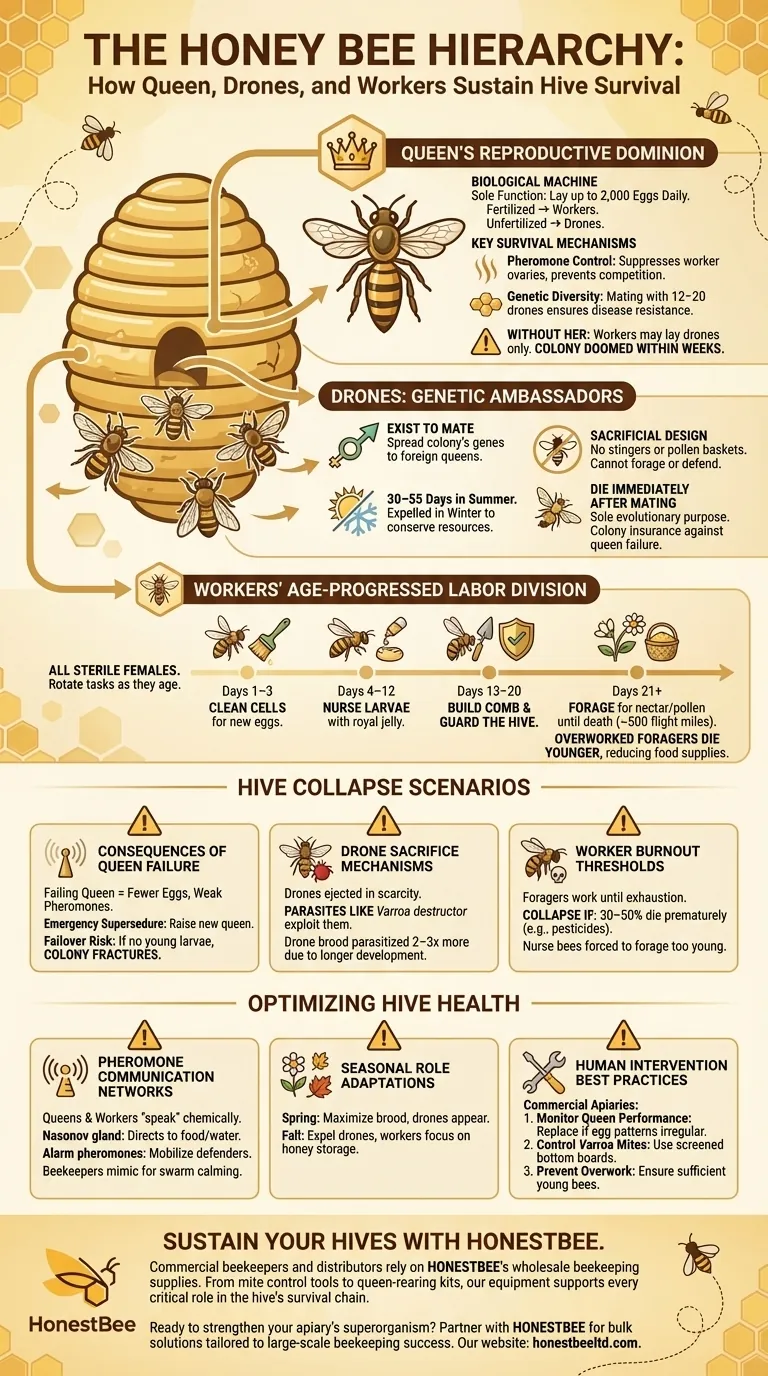
Queen’s Reproductive Dominion
The queen isn’t a ruler but a biological machine. Her sole function: lay up to 2,000 eggs daily, fertilizing most to create workers and leaving others unfertilized to produce drones.
Key survival mechanisms:
- Pheromone control: Her secretions suppress worker ovaries, preventing internal competition.
- Genetic diversity: Mating with 12–20 drones ensures disease-resistant offspring.
Without her, workers may lay unfertilized eggs (producing only drones), dooming the colony within weeks.
Drones: Genetic Ambassadors
Drones exist to mate with foreign queens, spreading their colony’s genes. They’re the only males, living 30–55 days in summer before being expelled in winter to conserve resources.
Sacrificial design:
- No stingers or pollen baskets; they can’t forage or defend.
- Die immediately after mating—their sole evolutionary purpose.
Colonies tolerate drones because they’re insurance against queen failure.
Workers’ Age-Progressed Labor Division
Workers (all sterile females) rotate tasks as they age:
- Days 1–3: Clean cells for new eggs.
- Days 4–12: Nurse larvae with royal jelly.
- Days 13–20: Build comb and guard the hive.
- Days 21+: Forage for nectar/pollen until death (~500 flight miles/lifetime).
This system ensures efficiency but has limits—overworked foragers die younger, reducing food supplies.
Hive Collapse Scenarios
Consequences of Queen Failure
A failing queen lays fewer eggs or produces weak pheromones. Workers may:
- Emergency supersedure: Raise a new queen from a young larva.
- Failover risk: If no young larvae exist, the colony fractures.
Drone Sacrifice Mechanisms
Drones are ejected when resources dwindle, but parasites like Varroa destructor exploit them first. Research shows:
- Drone brood is parasitized 2–3× more than worker brood due to longer development time.
- Warmer climates with year-round brood face higher infestation thresholds.
Worker Burnout Thresholds
Foragers work until exhaustion, but colonies collapse if:
- 30–50% of workers die prematurely (e.g., from pesticides).
- Nurse bees are forced to forage too young, reducing larval care.
Optimizing Hive Health
Pheromone Communication Networks
Queens and workers "speak" chemically:
- Nasonov gland signals: Direct foragers to food/water.
- Alarm pheromones: Mobilize defenders against threats.
Beekeepers can mimic these with synthetic pheromones to calm swarms.
Seasonal Role Adaptations
Colonies adjust behavior to seasons:
- Spring: Maximize brood production; drones appear.
- Fall: Expel drones; workers focus on honey storage.
Human Intervention Best Practices
Commercial apiaries can support hives by:
- Monitoring queen performance: Replace her if egg patterns become irregular.
- Controlling Varroa mites: Use screened bottom boards to disrupt parasite cycles.
- Preventing overwork: Ensure hives have enough young bees to replace foragers.
Sustain Your Hives with HONESTBEE
Commercial beekeepers and distributors rely on HONESTBEE’s wholesale beekeeping supplies to maintain healthy, productive colonies. From mite control tools to queen-rearing kits, our equipment supports every critical role in the hive’s survival chain.
Ready to strengthen your apiary’s superorganism? Partner with HONESTBEE for bulk solutions tailored to large-scale beekeeping success.
ビジュアルガイド