The High Cost of a Misplaced Trap
For a commercial apiarist, a swarm is not a wonder of nature; it's a line item in the red. It represents lost genetics, a drastic drop in honey production for the parent hive, and a direct hit to the season's revenue.
Yet, every year, thousands of dollars fly away.
The common mistake is one of human logic. We place swarm traps in locations that seem convenient, sheltered, or simply "look good" to us. We project our own sense of real estate onto the bees. But this approach fails because it ignores the fundamental medium through which a bee experiences its world.
Thinking in Scent, Not in Sight
To effectively intercept a swarm, you must stop thinking like a human and start thinking like a scout bee. For these remarkable navigators, the world is not a map of landmarks but a complex architecture of odors.
Their primary mission when a hive prepares to swarm is to find a suitable new home. Their most reliable tool for this search is not vision, but the invisible trail of scent wafting from their own colony.
The Invisible Highway: Understanding the Scent Plume
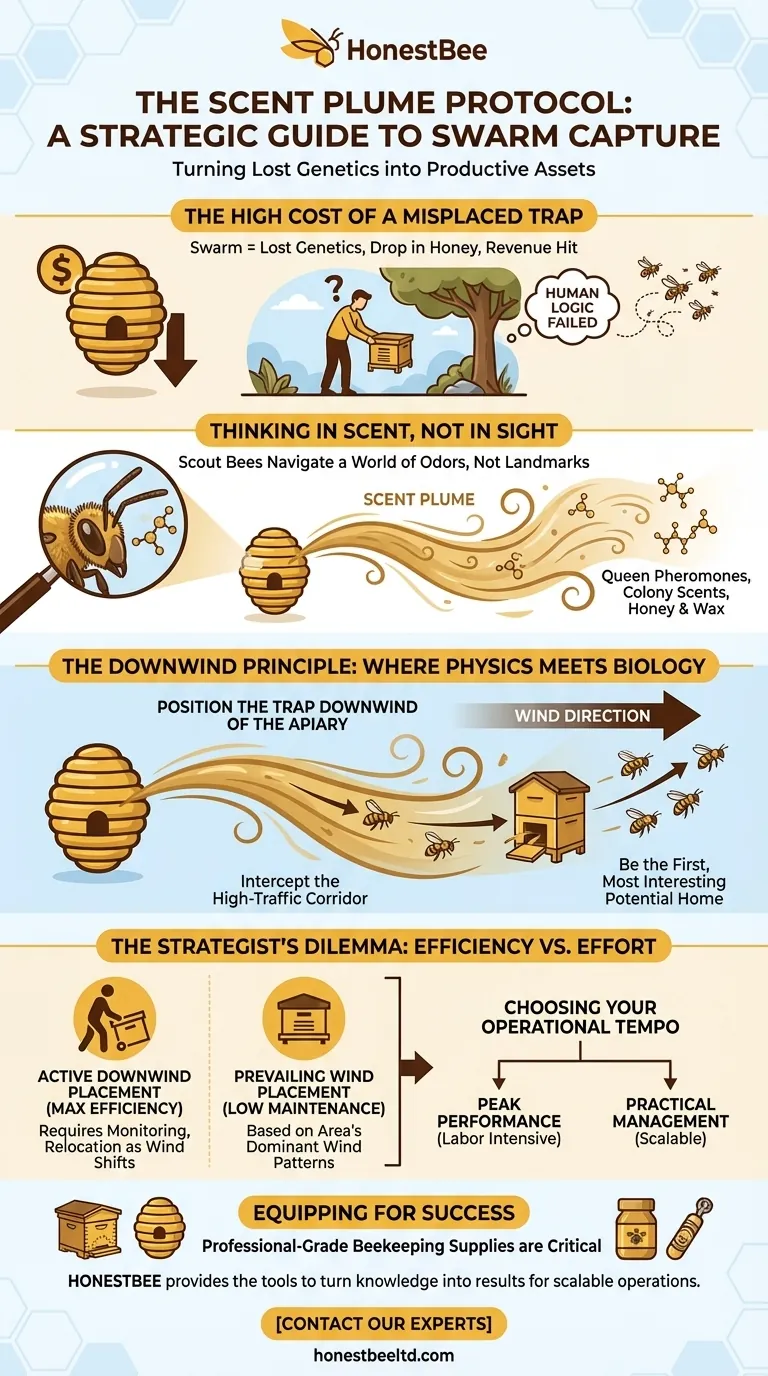
Every apiary constantly emits a complex cocktail of odors—queen mandibular pheromone, colony scents, the faint aroma of honey and wax. The wind picks up this signature and carries it outward, creating an invisible trail known as a "scent plume."
For scout bees, this plume is not just background noise; it's a navigational highway. They fly out from the hive and use the plume as a sensory beacon to orient themselves as they explore the surrounding territory.
The Downwind Principle: Where Physics Meets Biology
This brings us to the single most important rule of trap placement: position the trap downwind of the apiary.
This isn't about a specific distance or direction. It's a principle of interception.
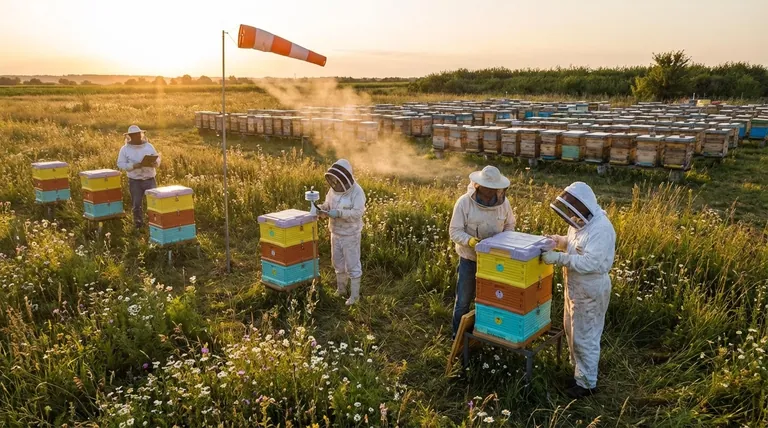
By placing your trap downwind, you are setting it directly in the high-traffic corridor that scout bees are already using. As they navigate along the familiar scent of a colony, your baited trap becomes the first, most interesting potential home they encounter. You're not asking them to find you; you're placing yourself directly in their path.
The Strategist's Dilemma: Efficiency vs. Effort
While the principle is simple, its application reveals a critical operational trade-off. The most effective strategy is also the most demanding.
The Unstable Variable: Shifting Winds
The scent plume is entirely dependent on the wind, and wind is notoriously fickle. A perfect downwind position at 9 AM can become a useless, unscented location by 3 PM if the wind changes direction.
This means that a trap left in a single spot is only optimally positioned for a fraction of the time.
Choosing Your Operational Tempo
Your trapping strategy must align with your resources and goals. This is a choice between peak performance and practical management.
| Strategy | Best For | Key Consideration |
|---|---|---|
| Active Downwind Placement | Maximum Capture Efficiency | Requires active monitoring and relocation as wind changes. |
| Prevailing Wind Placement | Practical, Low-Maintenance | A "best guess" based on your area's dominant wind patterns. |
For a large-scale commercial operation, even the "low-maintenance" approach is a calculated, strategic decision. The "active" approach, while labor-intensive, can yield significantly higher capture rates, turning potential losses into productive new assets.
Equipping for Success
Executing either strategy effectively requires more than just knowledge. It demands equipment that is durable, effective, and easy to deploy, whether you are setting a static line of traps or actively managing them based on daily weather patterns. The quality of your swarm traps and lures is just as critical as their placement.
Choosing the right strategy is the first step; having the right equipment is what makes it profitable. For commercial apiaries and distributors focused on scalable, reliable solutions, HONESTBEE provides the professional-grade beekeeping supplies needed to turn this knowledge into results.
Contact Our Experts to build a more resilient and efficient apiary.
ビジュアルガイド
関連製品
- 30 cm プラスチック製入口穴ハチ花粉トラップとコレクター
- プラスチック蜂花粉トラップストリップ櫛キャッチャーコレクター
- ミツバチの花粉コレクターのための換気された皿が付いている取り外し可能なプラスチック花粉のトラップ
- 黒いプラスチックのカブトムシの巣箱の蜂の巣のカブトムシのトラップ
- 蜂の巣のカブトムシの捕獲用具のための再使用可能で明確で小さい蜂の巣のカブトムシの罠